Foundations
Slab or crawl space: which foundation suits a Georgia home
A slab and a crawl space are the two most common foundations under a Georgia house, and the right one usually comes down to your lot's slope, its soil and the moisture you're managing underneath the floor.
Updated September 25, 2026
What a slab and a crawl space actually are
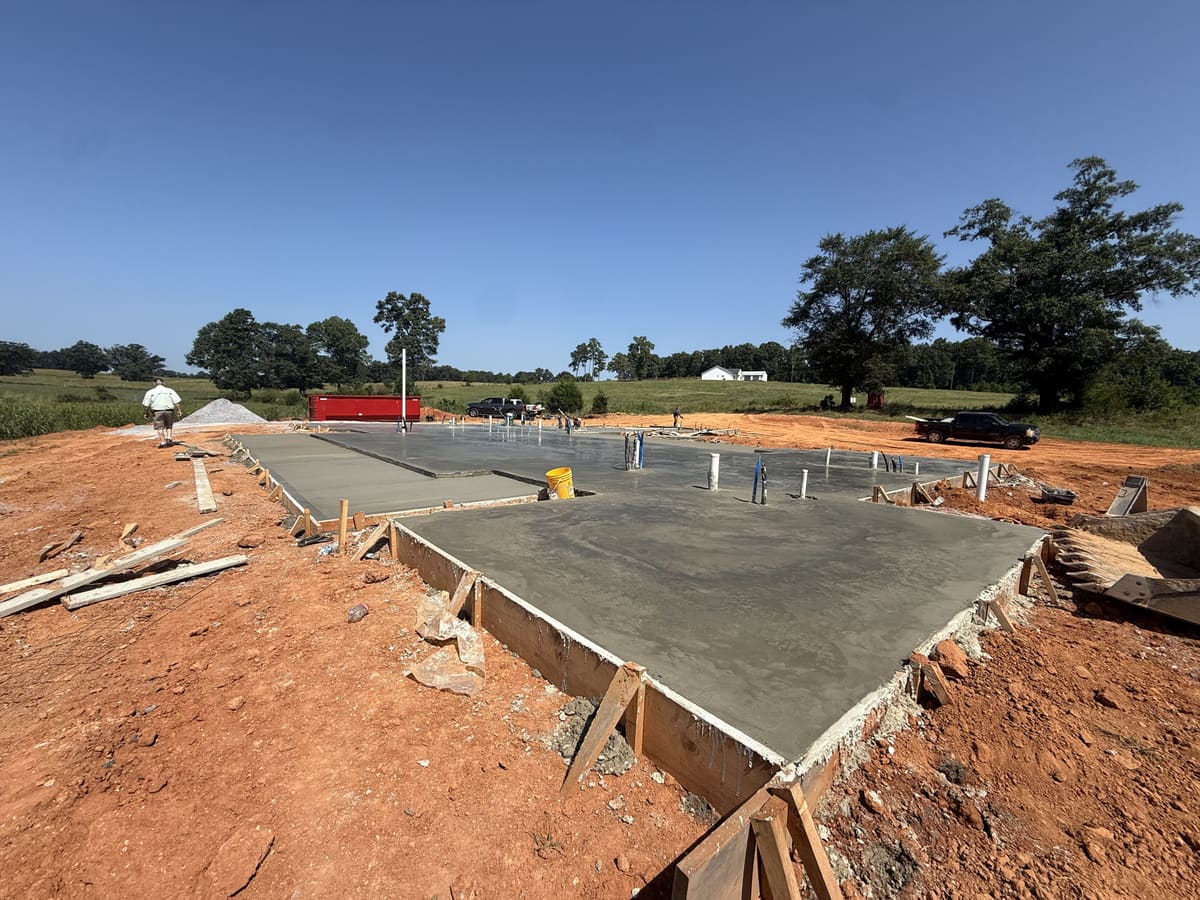
A slab on grade pours the house's floor directly on the ground, usually with a thickened edge to carry the walls above it. A crawl space instead builds a short foundation wall and leaves open, ventilated space between the ground and the floor framing.
A basement and a pier and beam foundation are two more options for a house; our guide to house foundation types lines up all four side by side if one of those is still on the table for you.
A barndominium faces many of the same tradeoffs under its metal or post-frame shell. Our barndominium guide covers how that decision plays out under a metal or post-frame shell.
How Georgia's humidity and moisture rules favor one or the other
A slab pours directly on the ground, while a crawl space suspends wood floor framing over open space that's often damp. So the state's building code requires ventilation under the floor to keep that moisture moving instead of sitting still.
The rule calls for at least one square foot of vent opening for every 150 square feet of crawl space, or a lighter allowance where the ground is covered with a vapor barrier instead. A slab skips that concern almost entirely, since there's no open space underneath for moisture to collect in.
Radon is part of the same conversation. The EPA notes that radon comes up out of the ground itself, through cracks and gaps in whatever sits between the house and the soil.
So radon is a factor for a slab as much as a crawl space. A radon test tells you more about your specific lot than the foundation type does on its own.
What termites mean for either foundation
Subterranean termites already live in the soil under most of Georgia. The University of Georgia's extension service is clear that whether they ever turn into a structural problem has more to do with how the house is built and kept up than whether termites happen to be nearby.
The state's building code requires termite protection on a house where the local risk calls for it. That protection gets met through chemical soil treatment, a baiting system, treated or naturally resistant wood, or a physical barrier built into the foundation itself.
A crawl space's open underside makes that protection easier to check on over the years. A slab seals it under the concrete the day it's poured, for better or worse.
Why red clay and a sloped lot often decide for you
Red clay that swells and shrinks with the seasons can move a slab unevenly if the pad underneath isn't prepared for it. Under a crawl space, that same clay only bears on the footings, not on a whole floor slab.
A sloped lot tips the scale further. A crawl space can step its foundation wall down a grade without much earthwork, where a slab usually needs the lot cut and filled flat first.
On a steep enough lot, that site work ends up mattering more to the decision than moisture or termites do.
Which one makes it easier to reach the plumbing?
A crawl space, without much argument. Pipes and ductwork running through open space under the floor stay reachable for the life of the house.
A leak or a repair means crawling under, not cutting concrete first. A slab puts all of that under concrete, simpler on install day, but any future work under the floor starts with a saw.
That tradeoff alone pushes some homeowners toward a crawl space even on a lot where a slab would otherwise be the simpler build.
How long does each one last, and what upkeep does it take?
Both hold up for the life of a house when they're built to the plans and the soil they sit on. A slab doesn't wear out on some faster timeline than a crawl space does.
A slab is typically the less expensive of the two to build, since it skips the extra foundation wall and the framing over open space.
It also takes some upkeep over the years, keeping vents clear and moisture under control, but it earns that back in easier access underneath. Our home foundations page covers the pour for either one, and telling us about your lot gets the conversation started.
What else do people ask about slabs and crawl spaces?
What are the downsides of a slab house?
A slab sets the plumbing and ductwork in concrete, so a repair under the floor means cutting into it instead of crawling underneath. It also sits the living space closer to the ground, which matters more on a lot that holds water after rain.
How long do slab homes last?
A slab holds up for the life of the house when it's built to the plans and the soil underneath, the same as any other foundation type. What wears out first is usually whatever's built on top of it, not the concrete itself.
Is a slab or a basement better?
Neither is automatically better: a basement adds usable space below grade but needs the right drainage and soil to hold up a below-grade wall. On a typical Georgia lot without a walkout slope, a slab or a crawl space ends up the simpler and more common choice.
Sources for this guide on slabs and crawl spaces
- Chapter 4 Foundations: Georgia State Minimum Standard One and Two Family Dwelling Code 2018 (UpCodes)
- Chapter 3 Building Planning: Georgia State Minimum Standard One and Two Family Dwelling Code 2018 (UpCodes)
- Termite Control Services: Information for the Georgia Property Owner, Bulletin 1241 (UGA Cooperative Extension)
- What is Radon? (US EPA)