Cost guides
What a concrete driveway installation costs in Georgia
A new concrete driveway's cost in Georgia comes down mostly to its size, its thickness and how much site work the job needs before the pour starts.
Updated September 25, 2026
Concrete driveway cost per square foot in Georgia
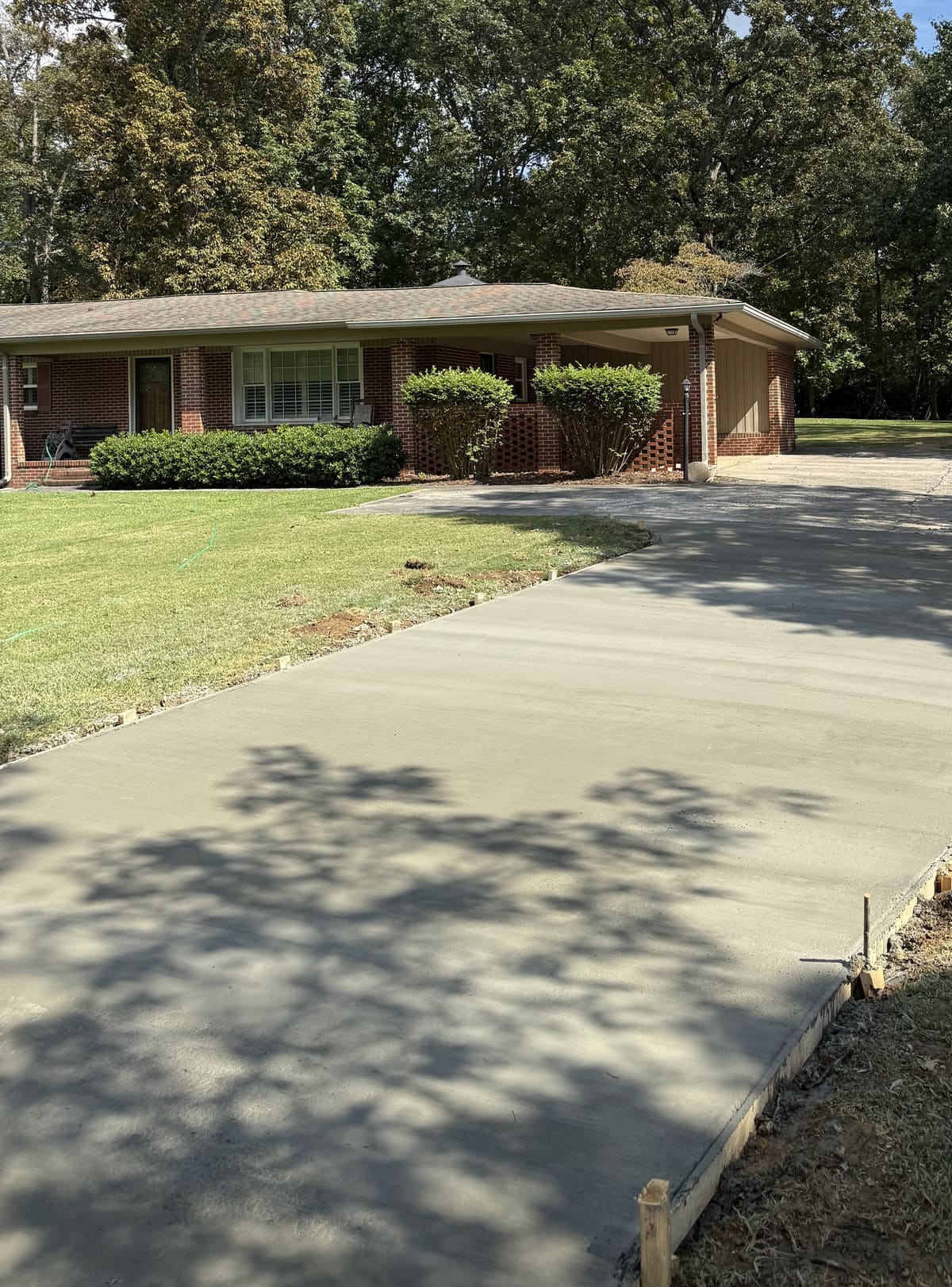
A new driveway or a driveway addition typically runs $12 to $36+ per sq ft. Where a given driveway lands in that range depends on the factors further down this page.
| Size | Typical cost |
|---|---|
| 12 x 20 (240 sq ft) | $2,900 to $8,600+ |
| 20 x 20 (400 sq ft) | $4,800 to $14,400+ |
| 24 x 24 (576 sq ft) | $6,900 to $20,700+ |
| 10 x 100 (1,000 sq ft) | $12,000 to $36,000+ |
Those numbers are for a standard, broom-finished driveway. A stamped section, heavier reinforcement for a work truck or extra grading before the pour can send a quote past the top end.
How much does a 20x20 concrete driveway cost?
A 400-square-foot pad, 20 feet by 20 feet, typically runs $4,800 to $14,400+ installed. That size is a short two-car pad, or a wide parking pad added beside an existing drive.
Getting the base right matters as much as the size does. A pad poured straight onto native soil, without a compacted gravel base underneath, is more likely to shift or crack early no matter how thick the slab is.
How much does a two-car driveway cost?
A two-car driveway wide enough to park side by side is often about 24 by 24 feet, or 576 square feet, which typically costs $6,900 to $20,700+.
The exact footprint varies with how the vehicles sit and how much turning room the driveway needs, so that figure is a starting point, not a fixed size for every home. A wider or deeper pad simply scales the same per-square-foot range up from there.
How much would a 100 ft concrete driveway cost?
A long driveway, 10 feet wide and 100 feet back from the road, comes out to 1,000 square feet and typically runs $12,000 to $36,000+.
A driveway that long doesn't always cost less per square foot than a short one either. There's more distance for the truck to reach, more joints to cut along the way, and more room for the site's grade to change from one end to the other.
What makes a driveway cost more
Thickness and reinforcement matter most. A driveway built for a work truck or a loaded trailer needs more of both than one that only ever sees regular vehicles.
Grading and clearing brush both take time before the first yard of concrete gets poured.
Access for the truck, the finish you choose and the distance from the plant all factor in as well. None of that shows up in a per-square-foot range on its own, which is why two driveways the same size don't always land at the same price.
Concrete compared with gravel, asphalt and pavers
Concrete costs more upfront than gravel and typically holds up longer with less regular upkeep. Our guide to types of driveways walks through how concrete, asphalt, gravel and pavers compare on cost, looks and maintenance.
If gravel is what you're actually weighing concrete against, our gravel vs. concrete guide goes deeper on that one comparison specifically.
Planning a new driveway or an extension
A full new driveway, a widened one and an added parking pad all start the same way, and our concrete driveways page covers how that work typically comes together, including what the site usually needs before the forms go in.
Tell us about your driveway and roughly where it sits, and we'll follow up about an estimate. The more you can tell us up front, the closer that first number will be.
What else do people ask about driveway costs?
Does a concrete driveway add value?
Buyers tend to see a concrete driveway as a finished, low-maintenance upgrade compared with gravel or a cracked older drive, which can help a home show better. How much it adds to resale depends on the local market and what's typical for driveways in that neighborhood.
How soon can you drive on a new concrete driveway?
Give it close to a week before regular vehicles park on it, even though the surface looks and feels solid within a day or two. Our guide on how long concrete takes to dry covers the full cure timeline, including when it reaches full strength.
How long does a concrete driveway last?
A well-built concrete driveway commonly lasts several decades with basic care, longer than gravel and typically longer than asphalt. How long any one driveway actually lasts depends on the soil underneath it, the climate and how heavy a vehicle regularly parks on it.