Cost guides
What it costs to pour a concrete slab in Georgia
What does it cost to pour a concrete slab in Georgia? It depends mostly on size, thickness and how much the site needs before the truck ever shows up.
Updated September 25, 2026
Concrete slab cost per square foot in Georgia
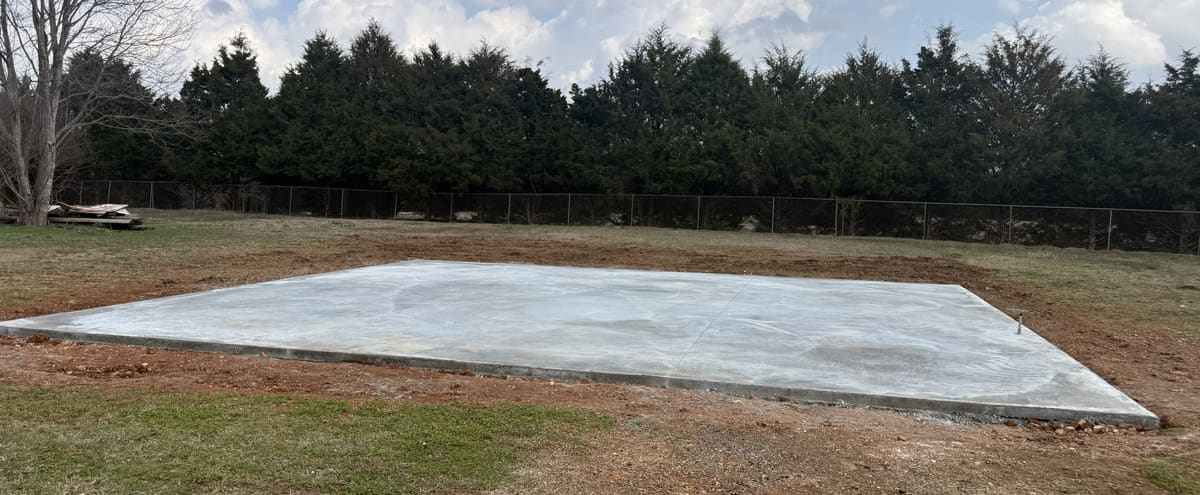
A slab for a garage floor, a shop or a pad typically runs $13 to $38+ per sq ft. That covers the concrete, the forms, the labor and the finish.
| Size | Typical cost |
|---|---|
| 10 x 10 (100 sq ft) | $1,300 to $3,800+ |
| 20 x 20 (400 sq ft) | $5,200 to $15,200+ |
| 24 x 24 (576 sq ft) | $7,500 to $21,900+ |
| 30 x 40 (1,200 sq ft) | $15,600 to $45,600+ |
| 40 x 60 (2,400 sq ft) | $31,200 to $91,200+ |
Those figures are for a plain, broom-finished slab at a typical residential thickness. A stamped finish, heavier reinforcement or a site that needs real grading first can push a job toward the top of that range, or past it.
How much would it cost to pour a 20x20 slab of concrete?
A 400-square-foot slab, 20 feet by 20 feet, typically runs $5,200 to $15,200+ installed in Georgia. That size shows up often as a garage floor or a workshop slab.
It's also large enough that site prep and how the truck gets in start to matter as much as the square footage does. Whether it needs rebar or mesh depends on what will sit on it and the soil, not the slab's size.
How much does a 40x60 concrete slab cost?
At 2,400 square feet, a 40 x 60 slab, roughly the footprint a shop building or a good-sized pole barn floor needs, typically runs $31,200 to $91,200+.
A slab that size usually costs less per square foot than a small one, since setting forms, getting the truck in position and finishing the surface all spread across more area. What does change is the scale of everything else: more yards of concrete, more finishing time before it sets, and a bigger window for weather to complicate the pour.
What changes what a slab costs
Thickness sits at the top of the list. A slab built to carry a vehicle or heavy equipment takes more concrete, and often more reinforcement, than one that only needs to hold foot traffic.
Site prep adds up fast too. Clearing an overgrown spot, breaking out an old slab or grading a sloped yard all take time before the first truck of concrete arrives.
Access matters more than most people expect. A site a truck can pull straight up to keeps things simple; one where the concrete has to be pumped over a fence or down a steep drive adds time and equipment.
The finish you choose and the distance from the plant factor in as well. Setup, forms and delivery don't shrink with the size of the job, so a very small pour often costs more per square foot than a mid-sized one.
Forms and a compacted base, before the truck shows up
Every slab starts with forms to hold its shape and a base underneath it, usually compacted gravel or well-graded soil, so the concrete has something solid and even to rest on.
Skipping that step, or rushing it, is the most common reason a slab cracks or settles later, no matter how good the pour itself looks on the day.
Whether a given slab also needs wire mesh, rebar or extra depth comes down to the soil underneath it and what's going to use it once it's poured. That's a fair thing to ask about while you're still comparing quotes.
From yardage to a real number for your slab
The most direct way to get a real number is to tell us the size and what the slab is for.
If you already have a shape in mind but aren't sure how much concrete it takes, our concrete calculator works out the yardage from a length, a width and a thickness.
For a closer look at what that yardage costs once it's delivered, our cost-per-yard guide breaks it down before it ever becomes a price per square foot. For the rest of the flatwork we pour, sidewalks and steps included, see our concrete flatwork page.
What else do people ask about slab costs?
Is it worth it to pour your own concrete slab?
For a small pad, mixing bags yourself can be worth it if you don't mind the labor and the cleanup. Anything much bigger gets impractical fast: even a 10 x 10 slab takes over a cubic yard of concrete, more than most homeowners want to hand-mix and place before the first batch starts to set.
How long before you can drive or walk on a new slab?
Most slabs are firm enough to walk on within a day or two. Give it closer to a week before regular vehicles park on it, and longer than that before it reaches its full rated strength. Our guide on how long concrete takes to dry covers the timeline in more detail.
How do you compare two slab quotes?
Line them up by what's actually included, not just the total: the thickness, the base prep, whether reinforcement is in the mix and what finish you're getting. Two numbers for what looks like the same slab often aren't quoting the same job underneath it.